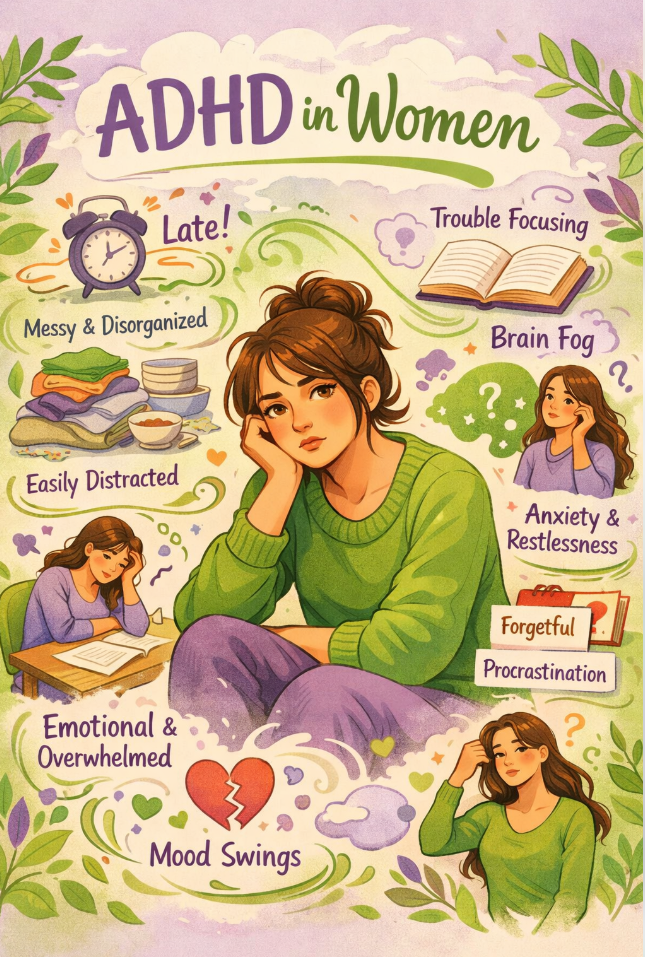
For decades, ADHD was considered a predominantly male disorder — the hyperactive boy who cannot sit still in class. This image left millions of girls and women in the shadows, struggling with inattention, overwhelm, and exhaustion without knowing why life seems so hard to manage. Recent studies show that ADHD affects women almost as frequently as men, but it manifests differently and is diagnosed far less often.
Why ADHD Is Underdiagnosed in Women
Research bias
Masking and compensating
Women with ADHD often develop sophisticated masking strategies:
- Double effort: Expending twice as much effort as peers for the same results
- Compensatory hyper-organization: Obsessive lists, elaborate systems that consume enormous energy
- Perfectionism: Impossibly high standards to compensate for feelings of inadequacy
- Social chameleon: Constantly adapting to others’ expectations, losing their own identity
- Internalization: Instead of externalizing (hyperactivity), they internalize (anxiety, self-criticism)
The result: they appear to cope on the outside; on the inside, they are exhausted.
How ADHD Presents in Women
Specific symptoms
Although diagnostic criteria are the same, the presentation differs significantly:
Inattention (primary presentation):
- Difficulty following long conversations or meetings
- Tendency to daydream (mind wandering)
- Frequent forgetfulness (keys, phone, appointments, deadlines)
- Difficulty completing tasks (especially boring ones)
- The sensation of “brain fog” — thinking feels clouded
Emotional regulation:
- Intense emotional sensitivity (easy crying, strong reactions to criticism)
- Rejection Sensitive Dysphoria (RSD) — intense emotional pain at the perception of rejection
- Rapid mood fluctuations, especially related to the menstrual cycle
- Overwhelm from multiple stimuli (noise, lights, simultaneous demands)
Internalized hyperactivity:
- Constant inner restlessness, not necessarily physical
- Thoughts that “won’t stop” (accelerated internal speech)
- Difficulty relaxing and “turning off” the brain at night
- The need for constant stimulation (compulsive scrolling, impulsive shopping)
Hormonal Impact
Hormonal fluctuations and ADHD
Estrogens directly influence dopamine levels in the brain. When estrogen drops, dopamine drops — and ADHD symptoms worsen. This explains why many women notice:
- Pre-menstrual: ADHD symptoms intensify 3-7 days before menstruation
- Postpartum: Dramatic worsening of symptoms after childbirth
- Perimenopause/Menopause: Many women are diagnosed for the first time during this period, when declining estrogen makes symptoms impossible to ignore
- Contraceptives: Can influence (positively or negatively) symptom severity
Discuss the interaction between hormones and ADHD with your doctor.
The Invisible Burden
Mental load
Awareness Exercise: Mental Load Audit
Women with ADHD often carry an enormous “mental load” — the invisible management of family and professional life. Do the following exercise:
- Write down absolutely everything on your mind right now: work tasks, appointments, birthdays to remember, what needs to be bought, bills to pay, children’s schedules, etc.
- Observe the length of the list
- Notice how many of these things are “invisible” — no one knows you are managing them
- Ask yourself: how many can be delegated, automated, or eliminated?
This exercise does not solve the problem, but it makes it visible — the first step toward change.
ADHD-specific burnout in women
- The masking phase: You compensate for symptoms through extra effort — you function, but at an immense energy cost
- The accumulation phase: Stress increases, sleep deteriorates, self-criticism intensifies — “why can’t I cope like everyone else?”
- The collapse phase: Burnout, severe anxiety, or depression — the moment when many women see a psychologist and receive an ADHD diagnosis for the first time
- The rebuilding phase: With the correct diagnosis, they can begin building adapted strategies and letting go of masking
Steps Toward Diagnosis
If you recognize yourself in this article, here is what you can do:
- Self-screening: Complete the ASRS (Adult ADHD Self-Report Scale) — available free online. It is not a diagnosis, but it indicates whether professional evaluation is warranted
- Document: Keep a journal for 2 weeks noting: when you feel overwhelmed, what tasks you postpone, how symptoms fluctuate with your menstrual cycle
- Find an informed specialist: Look for a psychologist or psychiatrist experienced in adult ADHD, preferably familiar with the presentation in women
- Involve someone: Ask your partner, a friend, or a family member to complete a questionnaire about the behaviors they observe
When to Seek Professional Help
- You recognize yourself in most symptoms described and they affect your life
- You have been diagnosed with anxiety or depression, but treatment does not fully work
- You feel you expend enormous effort just to function normally
- You have noticed symptom worsening during hormonal changes
- You feel “different” from other women and do not understand why life seems harder to manage
- You are exhausted from masking and compensating
Conclusion
ADHD in women is not a milder form of ADHD — it is a different form, often harder to identify but equally impactful. If you have spent your life wondering why everything seems harder for you, if you have always felt that you must work twice as hard as others for the same results — it may not be about discipline or character. It may be about the way your brain works.
You are not lazy. You are not disorganized by choice. You are not “too sensitive.” It is possible that you have a brain that works differently — and when you find that out, everything starts to make sense.
This article provides educational information and does not replace consultation with a mental health specialist. If you are experiencing persistent difficulties, I encourage you to schedule a consultation.